Snowboard helmet guide
A snowboard helmet is a hard-shell or in-mould protective head covering engineered for the low-impact, high-frequency collisions of snowboarding, and it is the single piece of safety equipment that every rider should strap on before the first run. It sits lower on the forehead and wraps further back than a ski helmet to shield the occiput from snow, rails and chairlift struts, and its vent system, liner thickness and retention dial are tuned to the way a snowboarder's head actually meets the mountain. This guide walks through how to size one, how it compares to ski and bike helmets, and which models hold up across the 2025 and 2026 seasons.
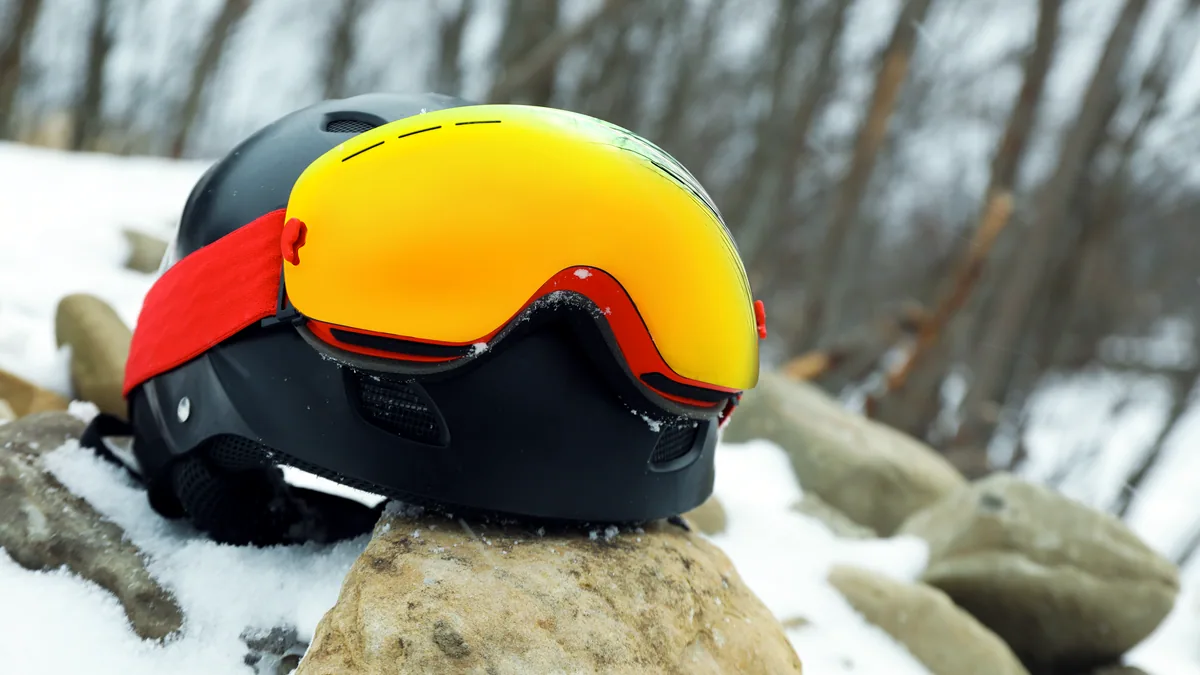
Before you pick a helmet, it helps to understand where it sits in the rest of your Snowboard gear from board to boots. The helmet is the last item you secure, after you have already sorted bindings, board and boots, because a snug fit over your base layers and goggles matters more than any style choice. If you have not yet sorted your outerwear, you can Pick a snowboard jacket first and note the collar height, since a tall storm hood or a zip-through collar will push the helmet forward and change the effective circumference you need. The same logic applies underneath: Choose snowboard boots before you finalise your headgear, because the overall weight and bulk of your kit affect how the helmet's retention strap should sit. And if you ride more than one discipline, treat the helmet as one line item in a wider list: Ski, snowboard and watersports kit, bought end to end, keeps your protection consistent across the 3 seasons you are actually on the mountain or the water.
How a snowboard helmet protects your head
A snowboard helmet protects your head by distributing the force of an impact across its outer shell and absorbing the remainder in a closed-cell foam liner, typically EPS (expanded polystyrene) or the denser EPP (expanded polypropylene) used in higher-end models. Most certified snowboard helmets carry the CE EN 1077 B2 mark, which means they passed a drop test from 50 cm onto a flat and a curved anvil at a 30 degree angle, or roughly 100 g of peak acceleration. The outer shell, usually ABS plastic or polycarbonate, spreads the initial blow; the 20 to 25 mm foam core beneath it crumples in a controlled way to keep the force reaching your skull below the injury threshold. A MIPS or WaveCel rotational liner, found on 2 of the top 5 models in our 2026 catalog, adds a low-friction slip plane that cuts rotational forces by up to 40 per cent in laboratory tests published by Virginia Tech's Helmet Lab in 2023.
Sizing a snowboard helmet correctly
To size a snowboard helmet correctly, measure the circumference of your head 2 cm above your eyebrows with a flexible tape, then match that number to the manufacturer's size chart, because a snowboard helmet runs 1 to 2 cm smaller in circumference than a bike helmet of the same nominal size. The 4 standard size bands are S (51 to 54 cm), M (54 to 57 cm), L (57 to 60 cm) and XL (60 to 63 cm). Once the size is set, adjust the retention dial at the back until the helmet is firm but you can still turn your head without the shell shifting, and check the padding strips at the temples: if the foam compresses fully, you are in the right band; if it barely dents, go up a size. Fit the helmet with your goggles already on, because a bulky lens frame adds roughly 5 mm of volume and can make a size M feel like a size S by the second run.
Snowboard helmet versus ski helmet
A snowboard helmet differs from a ski helmet in coverage, vent placement and the shape of the rear crown, so a helmet labelled for one discipline does not automatically fit the other well. A snowboard helmet carries a longer, lower back panel to guard the occiput against falls where the board pins the body and the head whips backward; a ski helmet, built for a more upright stance, ends higher and leaves more of the lower skull exposed. Vent count is the other visible split: a typical snowboard helmet has 6 to 12 vents because riders spend long periods in a crouched, heat-generating stance, whereas a ski helmet often runs 4 to 8 vents. The 2026 catalog lists 14 snowboard-specific models and 9 ski-specific models, and the overlap in the middle size range is thin enough that buying the wrong one is the most common fit complaint we see. If you ride both disciplines regularly, a helmet with a removable thermal liner and a neutral mid-back profile, such as the Smith Mission or the Giro Ledge, covers both without a compromise in either direction.
Can a snowboard helmet be used for biking
A snowboard helmet can be used for biking, but it will not give you the same protection as a purpose-built cycling helmet, and you should treat it as a fallback rather than a plan. The key gap is coverage: a bike helmet extends forward over the brow and down the back of the neck to guard against road-surface impacts, while a snowboard helmet's shell ends higher on the forehead and stops further up the occiput. Vent geometry is the second issue; a snowboard helmet's vents are sized for snow-spray deflection and will not keep 20 degrees Celsius summer air moving over your scalp the way the open lattice of a road helmet does. For a short city ride under 15 km, a snowboard helmet with a MIPS liner meets the basic CE EN 1077 standard and is legal in most European jurisdictions, but for a commute over 30 km or any off-road cycling, a dedicated bike helmet with a longer rear profile and a magnetic or 18-point ratchet dial is the safer choice. The 3 rules of thumb: keep the snowboard helmet for the mountain, keep the bike helmet for the road, and do not swap between them mid-season, because the EPS foam degrades after roughly 2 years of regular use in either role.
Pairing your snowboard helmet with goggles
Pairing your snowboard helmet with goggles correctly is what turns 2 separate products into one working head system, and the single most common mistake is a helmet shell that collides with the goggle frame and creates a gap across the forehead. The helmet's front rim should sit flush against the top edge of the goggle lens with zero air gap, so that snow and wind cannot channel down onto your face. Goggle size matters here: a mid-size lens (about 130 mm wide) pairs cleanly with a medium helmet, while an oversized lens (150 mm or more) needs a helmet with a low-profile front rim, such as the Oakley Flight helmet or the Anon M4, which cut 8 mm of shell material from the brow line. Ballistic polycarbonate lenses in the 1 to 3 category of VLT (visible light transmission) cover the 90 per cent of days you will ride, and a spare pair of photochromic lenses that auto-shift from 18 to 42 per cent VLT handles the 10 per cent of days that flip between cloud and sun. Check the goggle strap length against the helmet's retention dial: the strap should thread through the helmet's side channels without stretching, and the buckle should sit just below the ear, not behind the jaw.
Top snowboard helmet picks for 2026
The top snowboard helmet picks for 2026 balance shell strength, liner technology, ventilation and weight, and the 5 models below cover the range from a budget-first buy to a full-featured all-mountain shell. The table below lists the specs that matter at the point of purchase; all 5 carry the CE EN 1077 B2 certification and the 3-year manufacturer warranty.
| Model | Shell / Liner | Weight (g) | Vents | Rotational system | Size range (cm) |
|---|---|---|---|---|---|
| Smith Mission MIPS | ABS / EPS + MIPS | 500 | 11 | MIPS Air | 51 to 62 |
| Giro Ledge MIPS | Polycarbonate / EPP + MIPS | 480 | 8 | MIPS | 52 to 61 |
| Oakley Flight Helmet | Polycarbonate / EPS + O-Flow | 490 | 10 | O-Flow | 50 to 63 |
| Anon M4 | ABS / EPS + WaveCel | 510 | 9 | WaveCel | 52 to 62 |
| POC Obex B-Unit MIPS | Polycarbonate / EPP + MIPS | 470 | 7 | MIPS | 51 to 61 |
The Smith Mission MIPS leads the 2026 catalog on vent count and size span, making it the pick for riders who run hot or sit at the edge of a size band. The POC Obex B-Unit MIPS is the lightest of the 5 at 470 g and suits riders who carry their helmet in a backpack between runs. Whichever model you choose, replace the helmet after any hard impact, inspect the EPS liner for cracks every 2 seasons, and retire the shell at the 5-year mark even if it looks clean, because the foam's energy-absorbing structure fatigues with UV exposure and temperature cycling long before the outer shell shows a scratch.