Reading a snowboard design
Snowboard designs are the combined geometry, internal construction and material choices that define how a board behaves under a rider's weight. Every board sold carries a spec sheet listing its effective edge, sidecut radius, profile class, flex rating and core type, and those 5 numbers determine whether the board suits your weight, your terrain and your current skill level. A rider who weighs 70 kg and carves groomed runs needs a different design than a 60 kg rider who parks on jib boxes, and the spec sheet is the only place where that difference is stated in measurable terms.
Most of the confusion around these specs comes from the fact that each manufacturer names the same underlying categories differently. Burton calls a twin-mirror shape a "twin," K2 calls a slightly directional version a "directional twin," and Jones calls a freeride board with a setback stance a "directional." The physical principles behind every board on the market are the same, and once you can read the geometry, the brand vocabulary stops being a barrier. A structured Snowboard buying guide walks through the full decision tree, from choosing a length that matches your height and weight to matching the profile to the terrain you ride most. Riders who are still working through the basics will find a dedicated path in Learning to snowboard from zero, and the boots you pair with the board matter just as much as the board itself, which is why a separate step to Choose snowboard boots sits between picking your design and hitting the snow. And if you plan to race the 4-person gates on a marked course, the design priorities shift entirely, which is covered under What is snowboard cross.
Reading the shape: direction and stance
The shape of a snowboard is described by where the rider stands relative to the board's midpoint and whether the nose and tail are identical. A twin-mirror design has the same radius on both ends and a centered stance, so the board performs identically riding regular or switch. A directional design moves the stance 2 to 4 cm toward the tail and shortens the effective tail edge, which loads the nose for powder and keeps the tail planted in hard-pack turns. A directional-twin sits in between, with a 1 to 2 cm setback and slightly different nose and tail profiles, and it is the most common shape in the mid-range price band because it covers groomed runs, light powder and park hits without excelling at any single one. The stance width is measured from the center of the front binding to the center of the rear binding, and a 56 cm to 58 cm stance is typical for a rider who stands 175 cm to 185 cm tall. The wider the stance, the more stable the board feels at speed, but the harder it is to initiate quick carve transitions.
Sidecut and effective edge
Sidecut is the carved-in curve visible along a board's edges, and it controls the radius of a turn. Manufacturers measure it as a single radius in metres, and the 3 main ranges you will see on a spec sheet are 12 m to 14 m for a short-radius park board, 15 m to 17 m for an all-mountain design, and 18 m to 22 m for a long-radius powder or freeride board. A 14 m radius carves a tight arc, which is useful for linking quick turns in a halfpipe or threading through tight tree lines. A 20 m radius holds a wide, stable arc that lets the board glide across a groomer at speed without the rider fighting the turn. Effective edge is the portion of that sidecut that actually contacts the snow during a carve, and a board with a 120 mm waist width typically carries an effective edge of 115 cm to 125 cm. Shorter effective edges, found on boards with pronounced rocker in the nose and tail, reduce the contact patch and make the board looser, while a long effective edge increases grip but demands more edge pressure to initiate a turn.
Profile classes and camber geometry
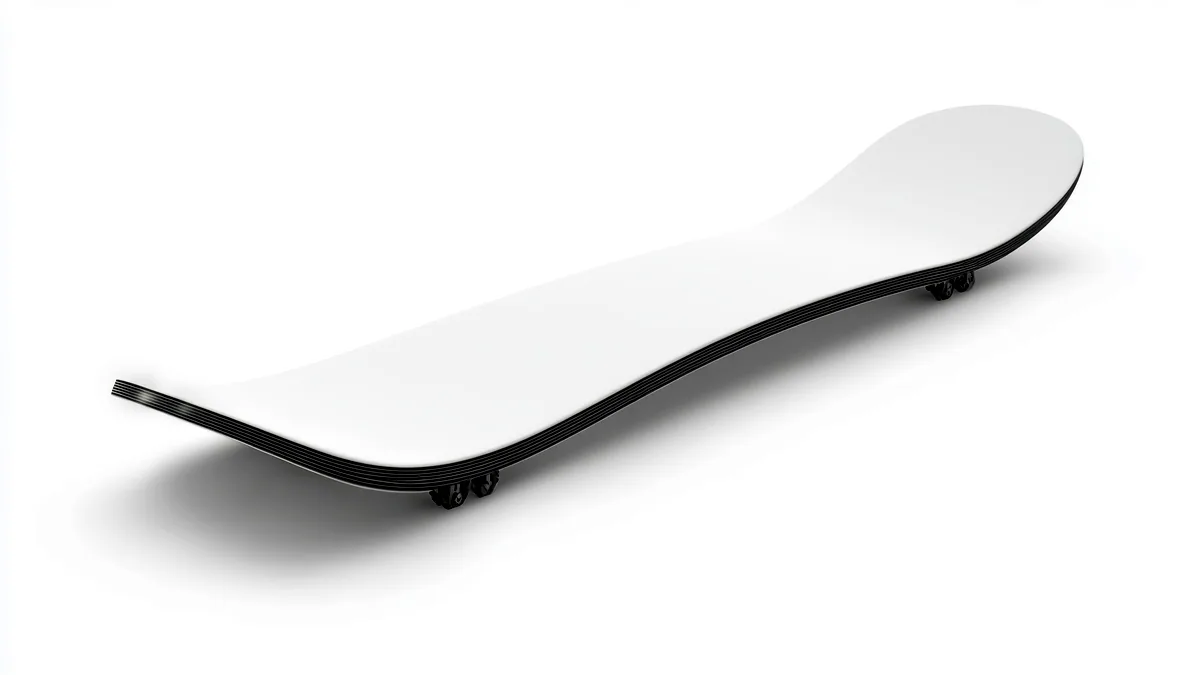
Profile is the shape of the board when you look at it from the side, and it is the single spec that changes the feel of a design more than any other number. The 4 profile classes you will encounter on a spec sheet are full camber, rocker (reverse camber), flat and hybrid. Full camber arches upward in the middle, so the board stores and releases energy through a turn, giving a 25% to 30% increase in pop compared with a flat profile. Rocker curves downward, so the nose and tail lift before the board lands, which reduces the chance of catch at the contact point and makes the board more forgiving for a rider who is still learning to transfer weight. Flat profile has zero curve through the center, which makes it stable at speed but dull in a carve. Hybrid profiles blend sections of camber under the feet with rocker in the nose and tail, and they are the most popular class in the 2024 and 2025 lineups from Burton, Jones and K2 because they split the difference between pop and forgiveness. The camber measurement itself is typically 2 mm to 8 mm at the center, and a 5 mm camber under a 75 kg rider stores enough energy for a solid jump takeoff without demanding the precise edge control of an 8 mm race board.
Flex ratings and how they interact with weight
Flex is rated on a 1-to-10 scale by each manufacturer, and a 5 flex is the midpoint that most all-mountain boards target. A 3 flex board bends easily under a 55 kg rider and gives a playful, surfy feel in soft snow, but the same board under a 90 kg rider feels mushy and loses edge hold on hard ice. A 7 flex board resists bending under that 90 kg rider and holds a clean edge in a carve, but the same board under a 55 kg rider feels stiff and transmits every bump through the boots. The flex number is not absolute across brands because each company calibrates its own scale, so a Burton 5 and a Capita 5 do not feel identical. When you read a spec sheet, match the flex to your body weight and the terrain you ride most, and if you sit between two sizes, the stiffer board will age better because a soft board wears out faster under a heavier rider. The torsional flex, which is how the board resists twisting side to side, is a second flex dimension that some brands rate separately, and a high torsional number locks the board in a carve while a low torsional number lets the board flex through the turn for a surfier feel.
Core materials and the construction stack
The core is the structural center of the board, and the 3 core materials you will see in a spec sheet are poplar, bamboo and a poplar-bamboo blend. Poplar is light and consistent, which makes it the default core for most all-mountain and freeride designs. Bamboo strips add stiffness and snap without adding mass, and a board with a bamboo-reinforced core can hold a 7 flex while weighing 300 g to 400 g less than an all-poplar board at the same size. The construction stack above and below the core adds layers of sintered or extruded base, a topsheet, sidewall or p-tex construction and, on higher-end boards, a carbon or basalt sheet that adds directional stiffness. Sintered base material holds 20% to 30% more edge wax than extruded base, which is why race and freeride boards almost always use sintered base, while extruded base is more affordable and self-repairing for a rider who waxes at home. The sidewall construction, where the core extends up the edge of the board, adds 3 mm to 5 mm of extra material that resists edge damage from rock strikes and increases the board's overall stiffness by a small but measurable amount.
Matching the design to the riding
Choosing the right snowboard design comes down to stacking the specs against your actual riding. A rider who spends 70% of their time on groomed runs and 30% in trees wants a directional or directional-twin shape with a 16 m to 17 m sidecut, a hybrid camber-roller profile and a 5 to 6 flex matched to their weight. A rider who lives in the park wants a twin-mirror shape with a 13 m radius, a full camber or camber-roller hybrid and a 4 to 5 flex that loads and pops off the coping. A rider who chases powder in the backcountry wants a directional shape with a 3 cm stance setback, a 19 m to 21 m radius, a rocker-camber hybrid profile and a 4 to 5 flex that floats the wide nose. The board length, which is the one spec every rider measures first, is typically chosen at chin to nose height for an all-mountain design, 2 cm to 4 cm shorter for a park design, and 4 cm to 6 cm longer for a powder design. Once the length is set, the remaining specs in the design are tuned around that length, and the 5 numbers on the spec sheet should all point in the same direction before you put money down.