Training for the snowboard
Snowboard exercises are a set of balance, core, and leg-power drills that a rider performs off the mountain to build the 3 specific muscle groups a snowboard demands: the ankles that absorb uneven snow, the core that transfers weight edge to edge, and the quads and glutes that drive each turn. A rider who adds 30 minutes of targeted work 4 days a week measurably improves stance stability, turn speed, and the ability to absorb the 2 to 4 foot drops that make up a typical intermediate run.
These drills fit into the full gear-to-mountain pipeline that a Snowboard buying guide covers, the high-speed discipline of What is snowboard cross that pushes every muscle to its limit, the first-season curriculum in Learning to snowboard from zero where balance work matters most, and the complete kit breakdown in Snowboard gear from board to boots that shows how every piece of equipment loads a different part of the body.
Why snowboard exercises target the ankles, core, and legs
Snowboard exercises target the ankles, core, and legs because a snowboard binds both feet to a single rail, so the body must generate every turn, absorption, and edge change through those 3 chains with no poles and no independent foot placement to compensate. An alpine skier splits the load across 2 skis and 2 poles; a snowboarder concentrates the entire workload into a single stance. The ankle complex absorbs vertical shocks from mogules, ice patches, and the 6 to 10 cm edge bevel that a well-tuned base carries into every bump. The core rotates the shoulders over the board during each turn transition. The quads and glutes hold the squat that keeps the centre of gravity low through a 15 degree pitch run.
The 5 core exercises that build board-ready stability
The 5 core exercises that build board-ready stability are the side plank, the Pallof press, the dead bug, the Russian twist, and the plank hip dip. Each one loads the obliques, transverse abdominis, or hip flexors in the pattern a rider actually uses on the snow. Perform 3 sets of 10 to 12 reps of each, 3 times a week, and track progress by holding each rep 1 second longer every session. The table below maps each drill to the on-snow skill it reinforces.
| Exercise | Primary muscle | On-snow skill it builds |
|---|---|---|
| Side plank | Obliques and hip abductors | Staying level through a carved turn |
| Pallof press | Transverse abdominis | Resisting rotation under a landing |
| Dead bug | Lower abs and hip flexors | Keeping the hips stacked during an absorption |
| Russian twist | Rotational obliques | Initiating the upper-body lead into a turn |
| Plank hip dip | Glute medius and core | Shifting weight edge to edge without collapsing |
Pair the core circuit with a leg-power block so the snowboard exercises session stays complete from hip to toe. The next section covers that leg work.
Leg-power drills that drive turn speed and absorption
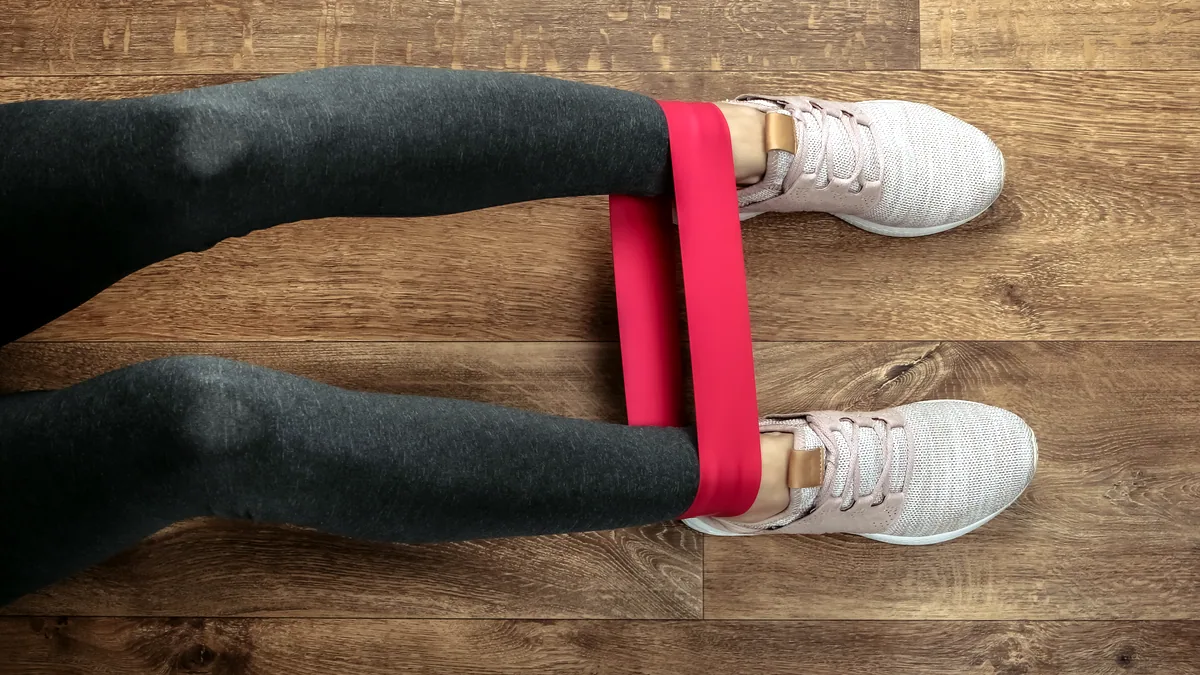
Leg-power drills that drive turn speed and absorption focus on the quads, glutes, and calves, the 3 groups that fire in sequence on every 4 to 6 second turn cycle. Build the set from 4 exercises: the single-leg Romanian deadlift for glute and hamstring strength, the Bulgarian split squat for quad endurance, the lateral band walk for hip-abductor stability, and the calf raise for the ankle dorsiflexion range a rider needs to stay over the front foot. Do 4 sets of 8 to 12 reps of each, rest 60 seconds between sets, and finish with 20 seconds of single-leg balance on a soft pad to close the loop back to the ankle work described in the opening section.
Progressing the leg block through the season
Progress the leg block through the season by adding load before you add reps. In the 6 weeks before the first lift, use bodyweight and bands. From week 7 to week 12, move to dumbbells of 8 to 16 kg per hand. In the final 2 weeks, hold the weight and cut rest to 30 seconds to mimic the sustained effort of a full day on the snow. This 3-phase ramp keeps the joints adapted before the 3 to 5 hours of repetitive loading a full day on the mountain delivers.
Balance and proprioception drills for the single-rail stance
Balance and proprioception drills for the single-rail stance train the 22 small stabiliser muscles around the ankle and hip that a snowboard rider relies on to keep the board flat through ice, wind, and the 1 to 2 cm swells of groomed corduroy. Start with the 3 drills: single-leg stance on a foam pad for 30 seconds per side, the wobble-board squat where you hold a 90 degree knee bend for 10 seconds while shifting your weight fore and aft, and the eyes-closed single-leg reach where you extend the free arm in 4 directions for 5 reps each. Perform them 4 days a week, ideally barefoot or in thin socks so the foot sensors work. A rider who adds this 10 minute block before the core circuit reports noticeably steadier first turns on day 1 of a new season.
Fitting snowboard exercises into a pre-season calendar
Fitting snowboard exercises into a pre-season calendar means scheduling 4 sessions a week across a 12 week block that ends 7 days before the first lift opens. The structure runs in 3 phases. Weeks 1 to 4 build the base: 2 core sessions and 2 leg sessions, 30 minutes each, with 48 hours of rest between same-group days. Weeks 5 to 8 add the balance block and raise load to the dumbbell range. Weeks 9 to 12 shift toward sport-specific patterns: add 2 jump-landing reps to each leg set, shorten rest to 45 seconds, and include 1 full-body plyometric session per week with 3 sets of 6 box jumps at 20 cm height. The 12 week total comes to roughly 48 sessions, each 30 to 40 minutes, which is enough volume to raise single-leg squat strength by 10 to 15 percent without the joint stress of a full-body program. A rider who completes the block walks onto the snow with the ankle, core, and leg strength that the drills were designed to install, and the first 2 days of the season feel measurably steadier than the first 2 days of the previous year.